Solana Token Launch Checklist (2026): 12 Steps Before You Click Launch
The full Solana token launch checklist for 2026. 12 steps covering tokenomics, liquidity, anti-sniper, post-launch monitoring. Free, with on-chain verification links.
Why a Checklist Matters
Most Solana token launches die in the first hour. Not because the idea was bad, but because something obvious got skipped: liquidity wasn't locked, mint authority wasn't revoked, the metadata could still be edited, or the launch happened in the same block as 12 sniper bots.
This checklist is the version we wish every founder had before their first launch. 12 steps grouped into 3 phases: planning, launch day, and the first 24 hours. Every item has a one-line "why" so you understand the trade-off, and a verification step so you can prove it on-chain.
If you can check off all 12, you've done more for your launch than 90% of the tokens that go live this week.
Phase 1: Pre-Launch Planning (do this 1–7 days before)
1. Lock the supply, decimals, and ticker before you write a single line of marketing
Total supply, decimals, and ticker are immutable once the mint is created. Changing them later requires launching a new token and migrating holders, which nobody actually does.
The sane defaults for a fungible launch:
- Supply: 1,000,000,000 (1 billion) is the modern norm. Visually obvious decimals, room for sub-cent prices.
- Decimals: 6. Enough granularity for any realistic price, plays well with most aggregators.
- Ticker: 3–5 characters, all caps, unique. Check Solscan and DexScreener for collisions before you commit.
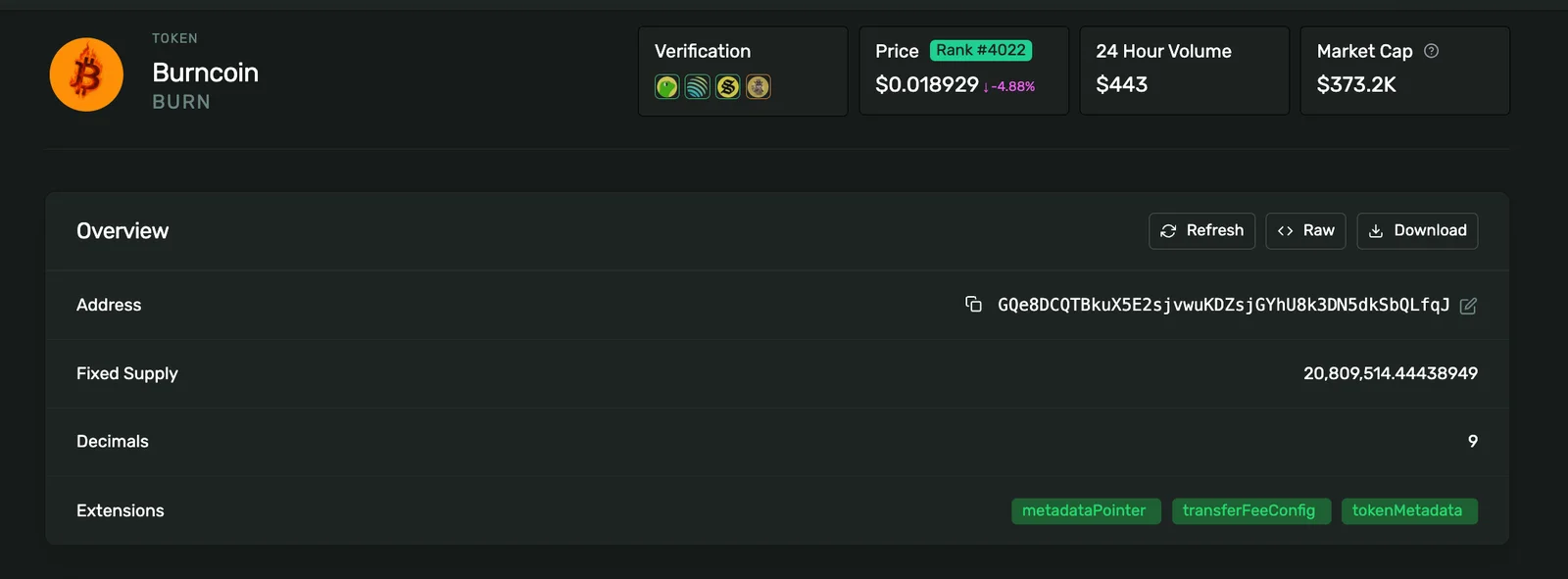
Verify after launch: open the mint in Solscan → "Overview" tab → check supply, decimals, and ticker match what you intended.
2. Decide your liquidity amount honestly
The single biggest first-launch mistake: too little SOL in the pool. Thin liquidity means a single 0.5 SOL buy moves the price 30%, which means the chart looks like a heart-attack monitor and real buyers refuse to trade.
Rough framework for initial SOL liquidity:
- Pure memecoin, no community: 1–3 SOL. Be honest, this is a coin-flip launch.
- Memecoin with small community (Telegram/Discord 100+): 3–10 SOL.
- Utility token, real product: 10–50 SOL minimum. Less than 10 SOL on a serious launch looks like a rug-prep.
- Major launch with marketing budget: 50+ SOL.
Whatever number you pick, lock 100% of it permanently. Anything else is a half-measure that holders see through immediately.
3. Plan the metadata before you mint
Token metadata (name, symbol, image, description, links) lives on-chain via Token-2022 or Metaplex. Once you set it, you have one chance to make it look professional.
What you need ready before you click launch:
- Square image, 512×512 minimum, transparent or solid background. Centered logo with breathing room.
- Description, 2–3 sentences, no marketing fluff. What the token is, who it's for, why it exists.
- Website URL that resolves (not a 404, not "coming soon").
- Twitter/X handle that exists and has at least one post.
- Telegram or Discord invite that doesn't expire.
Wallets render this metadata in real time. A pixelated logo and a dead link is the visual equivalent of "this is a rug."
4. Write the announcement before launch day, not during
Launch day is too noisy to write good copy. Have your launch tweet, Telegram message, and Discord announcement drafted 48 hours before, with the contract address slot left blank.
Each draft should answer:
- What the token is (one sentence)
- Why it exists (one sentence)
- Where to buy (link to your DEX or aggregator)
- What's locked / renounced (locked LP, revoked mint, frozen metadata)
- The fair launch window time, if you're using one
Schedule the tweet draft. Pin the Telegram message template. The moment your launch confirms, you fill in the address and ship. No scrambling.
Phase 2: Launch Day Configuration
5. Lock your liquidity at pool creation, not after
Locking liquidity in a separate transaction after the pool exists creates a window where you could rug. Even if you don't, holders watching the chain see the gap and assume the worst.
The correct flow: pool creation and liquidity lock in the same transaction. Permanent lock, no unlock authority, no you-can-pull-it-after-X-days clause.
This is the single most important trust signal in 2026. A pool with unlocked LP is treated as a rug-in-progress by every serious buyer.
Verify after launch: the LP token account shows the lock-program PDA as owner with no withdraw authority. SolFoundry surfaces this on the launch page; manually you can check the LP mint's largest holder on Solscan.
6. Revoke mint authority before announcing
If the mint authority is still set, you (or anyone with your private key) can mint infinite supply at any time. Buyers see this as a kill-switch and will not hold size.
Revoke mint authority in the same launch transaction, not later. Setting authority to null is a one-line instruction that costs ~0.000005 SOL.
Verify: Solscan → mint page → "Mint Authority" should show null or be marked "revoked". Same for Freeze Authority. If it's set, you can freeze any holder's tokens. Both should be null.
7. Freeze the metadata
Token metadata can be edited after creation if the update authority is set. This means name, symbol, image, and description can all be swapped. That includes swapping the image for a scam logo or pointing the website to a phishing clone.
Renounce the metadata update authority in the launch transaction. Once frozen, the token's identity is permanent.
Verify: Solscan → mint page → check the metadata's "Update Authority" field. Should be null.
8. Configure anti-sniper protection
Block-0 snipers will buy the moment your pool opens unless you make it expensive or impossible. There are two complementary tools:
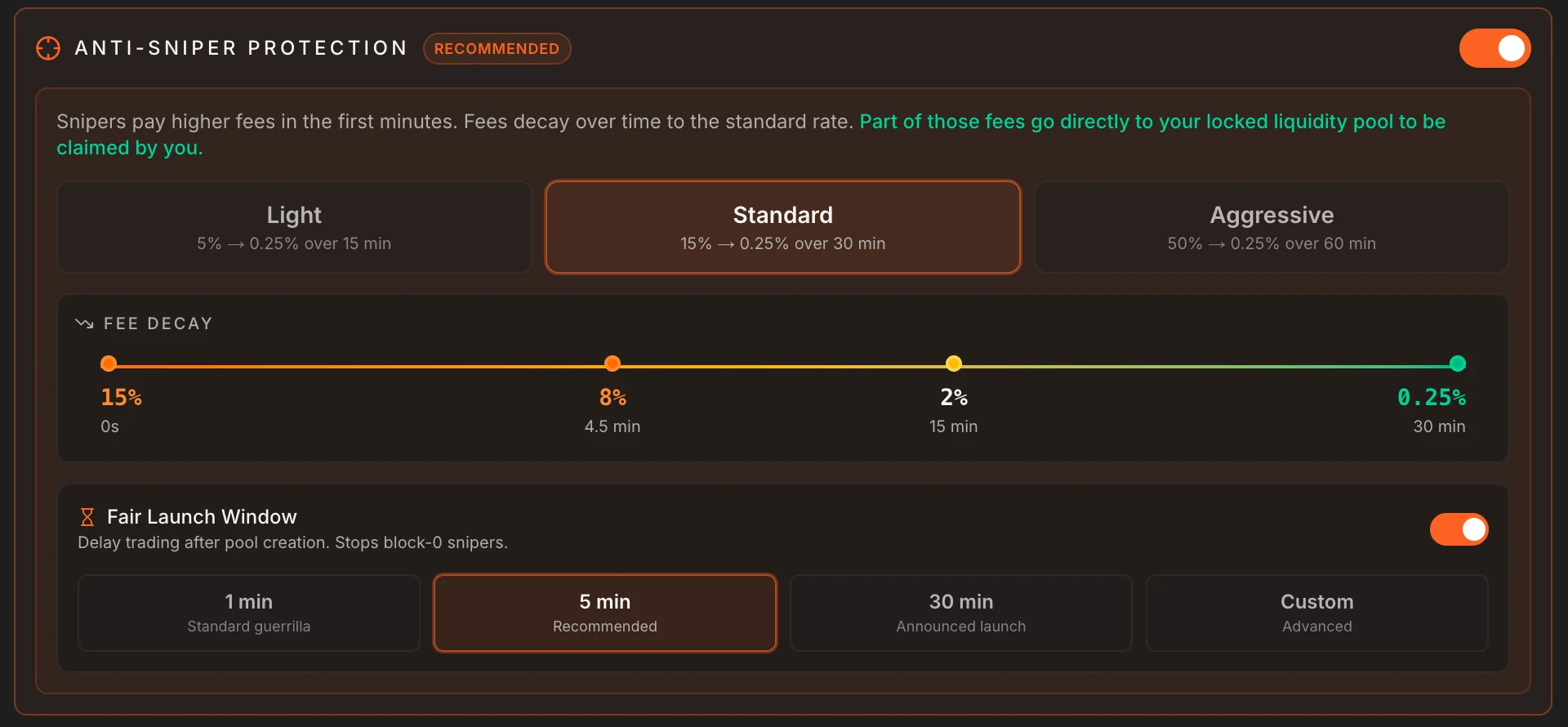
- Anti-sniper fee decay: trades pay a high fee (15–50%) immediately after launch, decaying to standard 0.25% over 30–60 minutes. Bots that buy early lose money to the fee; real buyers paying slightly elevated fees barely notice.
- Fair launch window: trading is delayed 30 seconds to 60 minutes after pool creation. The pool exists publicly, but every swap reverts until the activation timestamp.
Use both. The window blocks the first wave outright; the decay punishes the second wave economically. Together they remove the asymmetric speed advantage that makes sniping work.
Full guide to anti-sniper protection and fair launch window mechanics cover the details.
9. Decide the launch time and stick to it
Launching at a random time costs you 60% of the attention you could have captured. Pick a window where your audience is online and your competition is quiet:
- Best: Tuesday–Thursday, 14:00–18:00 UTC (US morning, Europe afternoon, Asia evening).
- Avoid: Weekends (low volume, low attention), Mondays (people are busy), 00:00–06:00 UTC (only Asia awake).
- Avoid major event days: big TGEs, exchange listings, or Solana ecosystem announcements steal all the oxygen.
Pair the launch time with a fair launch window of 5–30 minutes so your community has time to assemble before trading opens.
Phase 3: First 24 Hours
10. Verify everything on-chain in the first 5 minutes
Right after launch, before you announce anything, run through every check on Solscan:
- Mint authority: null
- Freeze authority: null
- Metadata update authority: null
- LP token: locked, owned by the lock program
- Pool activation timestamp: matches your fair launch window
- Anti-sniper fee schedule: matches what you configured
Take screenshots of each. If a buyer or community member asks "is the LP locked?", you reply with the Solscan link, not "trust me".
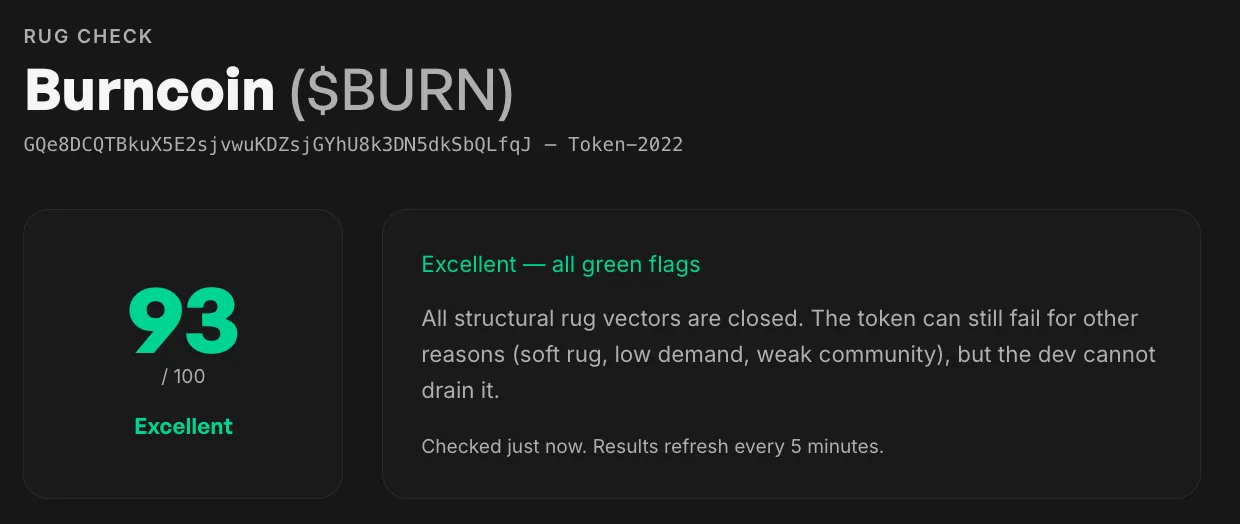
Use a free Solana rug check tool to get a 0–100 trust score on your own token before you announce, if it doesn't score 80+, you skipped a step.
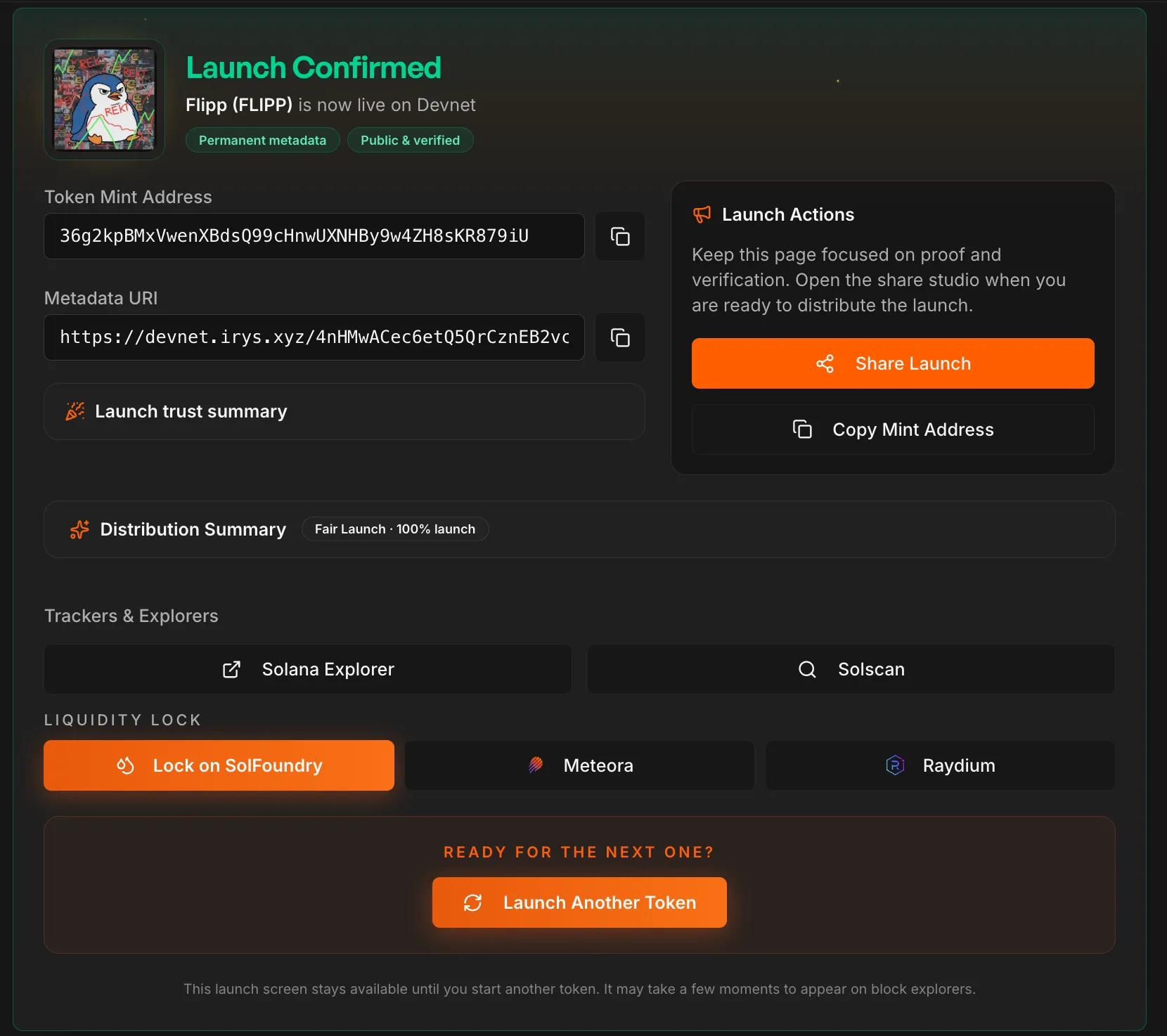
The same on-chain verifications appear on SolFoundry's launch success screen, with one-click links to Solscan and DexScreener so you can prove every check publicly:
11. Monitor the first hour for sniper activity
Even with anti-sniper and a fair launch window, watch the first hour of trades:
- Holder distribution: if a single wallet (not yours, not the LP) holds more than 5% within the first hour, that's a sniper or a coordinated buy.
- Trade pattern: a flurry of identical-size buys from new wallets at the activation second is bot activity.
- Sells in the first 30 minutes: snipers dump within the decay window. Track which wallets sell early, if they bought at activation, they're bots that paid the high fee and took the hit.
This isn't actionable in real time (you can't blacklist anyone on a fair launch), but it tells you what kind of holders you have. Adjust your communication to match.
12. Engage relentlessly for the first 6 hours
The first 6 hours of price action is set by attention, not fundamentals. If you disappear after the launch tweet, your token disappears with you.
What "engagement" looks like:
- Reply to every question in Telegram/Discord within 2 minutes.
- Quote-tweet anyone who tweets your contract address.
- Post one update per hour: holder count, volume, a chart annotation, anything that proves you're alive.
- If a buyer is confused or skeptical, send them the Solscan links from step 10. Trust signals only convert when they're put in front of people.
A token launch is not a button-click. It's an event you host live for 6 hours, then maintain for 6 weeks.
The Most-Skipped Items
If you only fix three things on this list, fix these:
- Lock liquidity at pool creation (step 5). Half the launches that fail had unlocked LP. Half of those rugged within 48 hours.
- Revoke mint authority (step 6). Skipping this costs you 80% of serious holders. They check Solscan; if mint authority is set, they leave.
- Use anti-sniper + fair launch window together (step 8). Sniper bots own the first 30 seconds of every unprotected launch. Your real community ends up buying after a 200% sniper pump.
Everything else on the checklist is optimization. These three are non-negotiable.
How SolFoundry Handles the Checklist
We built SolFoundry because we were tired of doing this checklist by hand for every launch. (If you're still comparing platforms, our guide to picking a Solana launchpad maps this same checklist onto the launchpad decision.) The platform bakes most of it into a single launch transaction:
- Supply, decimals, ticker, metadata: configured in the launch flow with sane defaults.
- Liquidity lock: atomic with pool creation, permanent, no unlock authority.
- Mint authority + freeze authority + metadata update authority: all renounced in the same transaction.
- Anti-sniper fee decay: three presets (Light/Standard/Aggressive) plus custom.
- Fair launch window: 30s–60min slider.
- Solscan + DexScreener links: surfaced on the success screen so you can verify everything in one click.
What we don't do for you: pick the launch time, write the announcement, engage with holders. Those are still on you.
FAQ
Can I do all this without SolFoundry? Yes, but you'll need the Solana CLI, the Metaplex JS SDK, the Meteora SDK, a working understanding of Token-2022 extensions, and 4–6 hours of careful work per launch. Most founders don't have that bandwidth on launch day.
What if I skip a step? Any single skipped step is recoverable until you announce. Once the contract address is public, you can't fix mint authority or LP lock retroactively without launching a new token.
Do I need anti-sniper if my community is small? Yes. Solana sniper bots monitor every new pool creation, regardless of who's launching. Small communities are bigger targets, not smaller, there's no organic buying pressure to compete with the bots.
Is a fair launch window the same as a presale? No. A presale has an allocation and a whitelist. A fair launch window just delays trading; anyone can buy when it opens, with no special access.
What's the minimum SOL I should put into liquidity? For any serious launch, 5 SOL is the floor. Below that, the slippage on a single buy is high enough to scare real holders.
How long should my fair launch window be? 1–10 minutes for most launches. Long enough to break the block-0 race, short enough that you don't lose attention. 30 minutes if you're announcing the activation time in advance.
Can I edit metadata after launch if I freeze it? No. Freezing metadata is permanent. Plan the image, name, and links carefully before you mint.
What if I find a problem after launch? Depends on what it is. Wrong image: stuck with it. Wrong supply: stuck with it. Unlocked LP: lock it ASAP, but the trust damage is done. Mint authority not revoked: revoke it immediately. Most "problems" are actually unfixable, which is why this checklist exists.
Ready to launch with every item on this checklist handled atomically? Head to SolFoundry's launch flow, supply, lock, anti-sniper, fair launch window, and authority renouncement all in one signed transaction.
Keep reading
What to Do After Launching a Solana Token: 5 Steps (2026)
Minted your Solana token, now what? 5 post-launch steps: seed real liquidity, put supply in the pool, lock the LP, run a rug check, survive hour one.
How to Launch a Solana Token with Any Wallet (2026 Guide)
Launch a Solana token with any wallet: Phantom, Solflare, Backpack, or OKX. Step-by-step 2026 guide with anti-sniper protection and locked liquidity.
How to Create a Token on Solana Without Coding (2026)
Launch a Solana token with no code in under 10 minutes. Step-by-step guide for non-technical founders, with locked liquidity and anti-sniper protection built in.