How to Add Liquidity to a Solana Token: How Much SOL? (2026)
How to add liquidity to your Solana token and exactly how much SOL to seed the pool with. Real numbers by community size, slippage math, and what too little or too much actually does.
The Question Every First-Time Launcher Asks
You're about to launch a token on Solana. You've picked the name, designed the logo, written the description. The wallet is connected, the launch flow is open, and there's one box you don't know how to fill in: how much SOL to put in the liquidity pool.
Search around and you get the same useless answers: "depends on your project," "however much you can afford," "more is better." None of that helps you pick a number.
This guide gives you a number. Or rather, a range, because the right answer changes with what kind of launch you're doing. By the end you'll know:
- Why too little liquidity is the most common reason new tokens die in the first hour
- Why too much liquidity is the second most common
- The slippage math that separates "tradeable" from "untradeable"
- A specific SOL range based on your community size and launch type
Why Liquidity Even Matters
Liquidity is the SOL paired with your tokens in a trading pool. It's what buyers trade against. The size of the pool determines two things:
1. How much price slippage each trade causes. A small pool means a single buy can move the price 30%, 50%, even 200% on small trades. That looks like manipulation on a chart, even if it's organic. Real buyers see the chart and refuse to enter.
2. How much volume the pool can absorb before breaking. A pool with 1 SOL of liquidity can handle a few hundred dollars of buys before the price doubles. A pool with 50 SOL can handle real volume from real holders.
Get this number wrong in either direction and your launch is over before it starts.
The Slippage Math (Why Thin Liquidity Kills Launches)
Solana DEX pools use a constant-product formula: x * y = k. If you put 1 SOL and 1B tokens into a pool, every trade has to keep that product constant.
Here's what a 0.5 SOL buy does to pools of different sizes (assumes 1B token supply at launch):
| Pool size (SOL) | 0.5 SOL buy → price change |
|---|---|
| 1 SOL | +56% |
| 3 SOL | +33% |
| 5 SOL | +21% |
| 10 SOL | +11% |
| 25 SOL | +5% |
| 50 SOL | +2% |
A 56% price jump on a $50 trade looks like a pump-and-dump. A 5% jump on the same trade looks like an organic launch. Both happened with the same buyer.
This is the single most common reason memecoin launches die in the first 5 minutes: the founder put 1 SOL in the pool because they were nervous, the first organic buy of $30 moved the chart 50%, three more buys moved it 200%, and serious buyers looked at the chart, called it manipulation, and skipped it.
A 0.5 SOL buy moves a 1 SOL pool +56% — but a 25 SOL pool only +5%. Same buyer, same trade: one chart reads as a rug, the other as organic. Thin liquidity is the #1 first-hour killer.
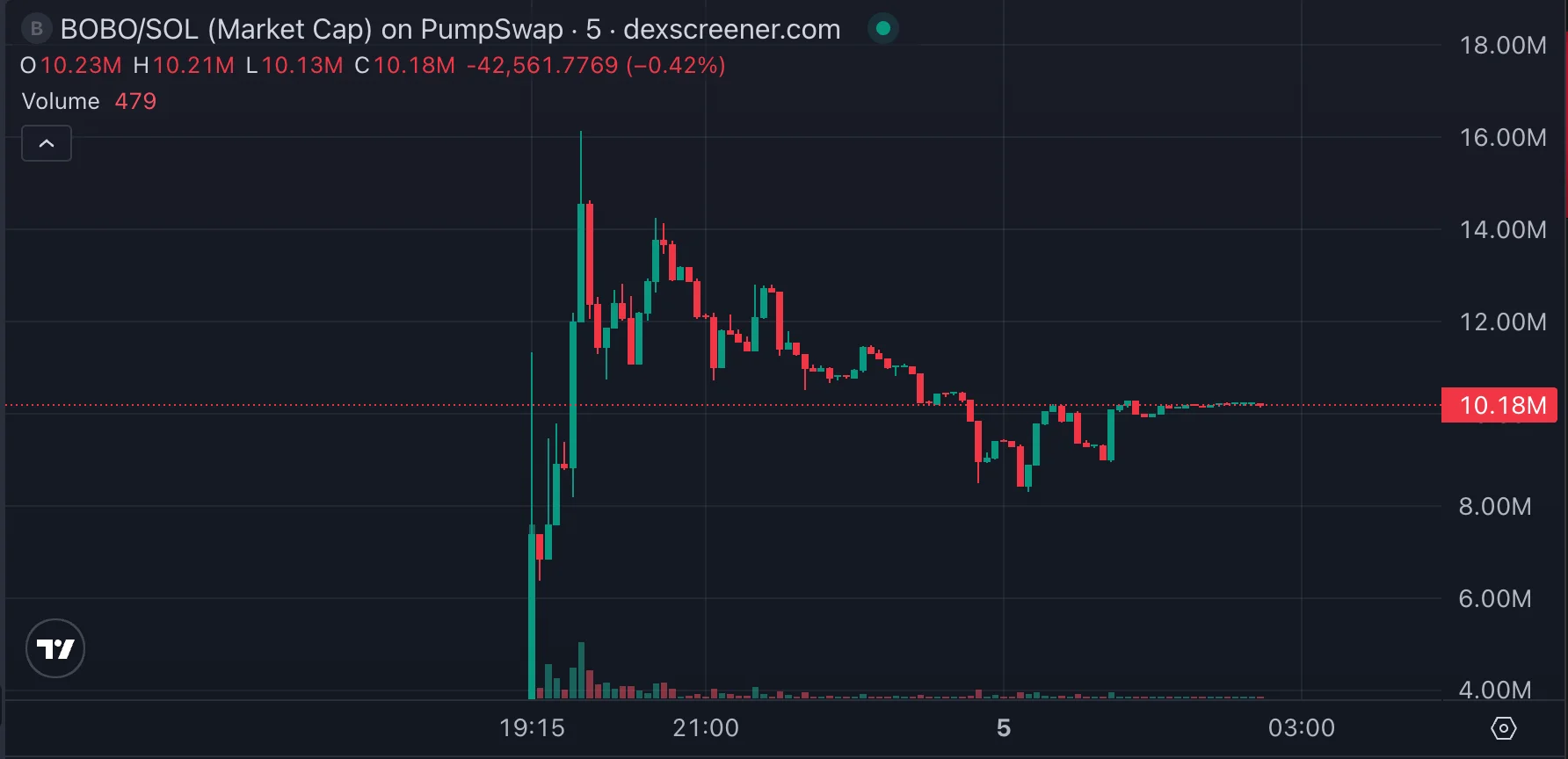
The chart above is a real Solana launch with under-funded initial liquidity. The first hour looks like a pump-and-dump even though most of the volatility is organic. Real buyers see this pattern and assume manipulation, then skip the launch entirely.
Why Too Much Liquidity Also Kills Launches
The opposite mistake is rarer but still common, especially with founders who have capital and want to "look serious."
A 100 SOL pool with no community to back it does the opposite: every buy barely moves the price. The chart is flat. Holders waiting for action see nothing happening and leave. Without volatility, a memecoin launch has no story. Without a story, no attention. Without attention, no buyers.
Utility tokens can survive a flat first hour because their value prop is fundamentals, not momentum. Memecoins can't.
The other downside of over-funding: you're locking that SOL forever. If your launch doesn't take off, you've put real money into a permanent lock with no exit. Liquidity is locked = locked. There's no "withdraw if it doesn't work."
The Honest Framework: SOL by Launch Type
Stop trying to pick a number from feel. Match it to your situation.
| Situation | Initial SOL liquidity | Why this number |
|---|---|---|
| Pure memecoin, no community, anonymous launch | 1–3 SOL | Coin-flip launch. Low capital at risk, low expectation of success. |
| Memecoin with small community (Telegram/Discord 100–500) | 3–10 SOL | Enough for the first hour to feel real without scaring the founder out of the trade. |
| Memecoin with active community (1k+ engaged) | 10–25 SOL | Liquidity matches the buying pressure your audience can produce. |
| Marketed launch with KOLs / paid promotion | 25–100 SOL | Pool needs to absorb the initial wave without the chart looking thin. |
| Utility token, real product, anonymous | 5–15 SOL | Lower than memecoin equivalents because volume builds slower. |
| Utility token with real audience | 15–50 SOL | Serious launches signal seriousness with real liquidity. |
| Major token launch with marketing budget | 50–200 SOL | Cost of doing business. Below this, the chart looks underfunded relative to the marketing. |
These ranges are calibrated for standard 1B supply tokens with 6 decimals. If your supply is dramatically different (10M tokens, 100B tokens), the slippage math changes proportionally and you should adjust.
The Sanity Check: 0.5 SOL Buy Test
Before you commit to a liquidity number, run this mental test:
"If a real buyer puts in 0.5 SOL right after launch, what does the chart look like?"
- If the price jumps more than 20%, your pool is too small. Add more SOL.
- If the price jumps less than 2%, your pool is too big for your audience. Reduce or wait until the audience grows.
- If the price jumps 5–15%, you're in the right range.
This single check rules out 90% of bad liquidity decisions.
What to Pair It With (the Other Half of the Pool)
Liquidity is SOL plus tokens, in the right ratio to set your initial price.
Token side: for memecoins, almost always 100% of supply goes into the pool. Any tokens kept in your wallet at launch are read by the audience as a future dump signal. The exception: utility tokens with explicit team allocations (which you've disclosed publicly) and a published vesting schedule.
SOL side: the number from the table above.
Initial price math: initial price = SOL / tokens. So 5 SOL paired with 1B tokens = $0.000000005 per token (at SOL = $100). This sounds like nothing, but on a 1B supply, that's a $5K initial market cap, which is the right range for an unknown token. As people buy, the price climbs along the bonding curve.
If you want a higher starting market cap, you need either more SOL or fewer tokens in the pool. Both have trade-offs. Most memecoins start sub-$10K market cap and let the curve do the work.
Skip the math. Claim your free slot.
Lock the platform fee to your wallet for your first launch. Network fees still apply (~0.02 SOL).
Claim Free SlotLock 100% of It. Always.
Whatever number you pick, lock 100% of the LP permanently. Anything less than 100% locked is read as a planned rug.
Specifically:
- No "lock with 30-day unlock": that's a 30-day timer to your exit.
- No "lock 80% and keep 20%": the audience sees the unlocked 20% and treats it as your dump bag.
- No "I'll lock it later, after the price stabilizes": the gap between launch and lock is exactly the window where every serious holder leaves.
Permanent, atomic, no-unlock-authority. That's the bar in 2026.
The platforms that do this in a single transaction include SolFoundry's Liquidity Lock, pool creation and permanent lock in one atomic step. If yours requires a separate transaction to lock, you're advertising the gap.
Adding More Liquidity Later
If your launch takes off, you can add more SOL and tokens to the same pool later. Most pool standards allow incremental deposits.
But there's a catch: new deposits don't have to be locked. If you add 20 SOL of fresh liquidity to your locked pool, that 20 SOL is yours to remove. The original locked portion stays locked, but holders watching on-chain see the new unlocked deposit and treat it as a rug-prep.
If you're adding liquidity later, add it locked. Otherwise you're undoing the trust you built at launch.
The Counterintuitive Move: Less Is Sometimes More
A 5 SOL pool with a real 200-person Telegram community will outperform a 50 SOL pool with no community.
Why: the first 30 minutes of trading on a memecoin is a coordination game, not an efficiency game. Volatility creates the chart pattern that pulls in spectators. Spectators become buyers. Buyers create more volatility. The flywheel needs initial momentum, not initial cushion.
Big liquidity is a moat, not a launch. It's the right move after you have organic volume, not before.
Does Anti-Sniper Protection Change How Much You Need?
Yes, at the bottom of the range. One of the reasons launchers over-seed pools is fear of block-0 bots: a thin pool is cheap for a sniper to drain, so "more SOL" feels like armor. Anti-sniper fee decay attacks that problem directly. When early buys pay a 15-50% fee that decays over the first minutes, draining a thin pool stops being profitable, the bot's edge is gone before the fee normalizes. (The mechanics are in our anti-sniper guide.)
Practical effect: with fee decay active from block 0, the low end of the framework above becomes genuinely usable. A Starter-range pool that would have been sniper bait as a naked launch is defensible with an Aggressive preset, because the first minutes, the window where thin liquidity is dangerous, are exactly the window the fee schedule covers.
What it does not change: steady-state depth. Once the fee decays to normal, your pool needs the same liquidity as any other pool to absorb real buys without silly slippage. Fee decay buys you a safe opening, not a smaller long-term pool. Configure both together when you create and lock the pool.
How SolFoundry Handles This
After the token launch, SolFoundry's Liquidity Lock step surfaces a recommended SOL range based on your token supply, with a slider for fine-tuning. Three Quick Presets (Starter, Balanced, Deep Liquidity) match the framework above so you can pick the right depth for your community without doing the math yourself.
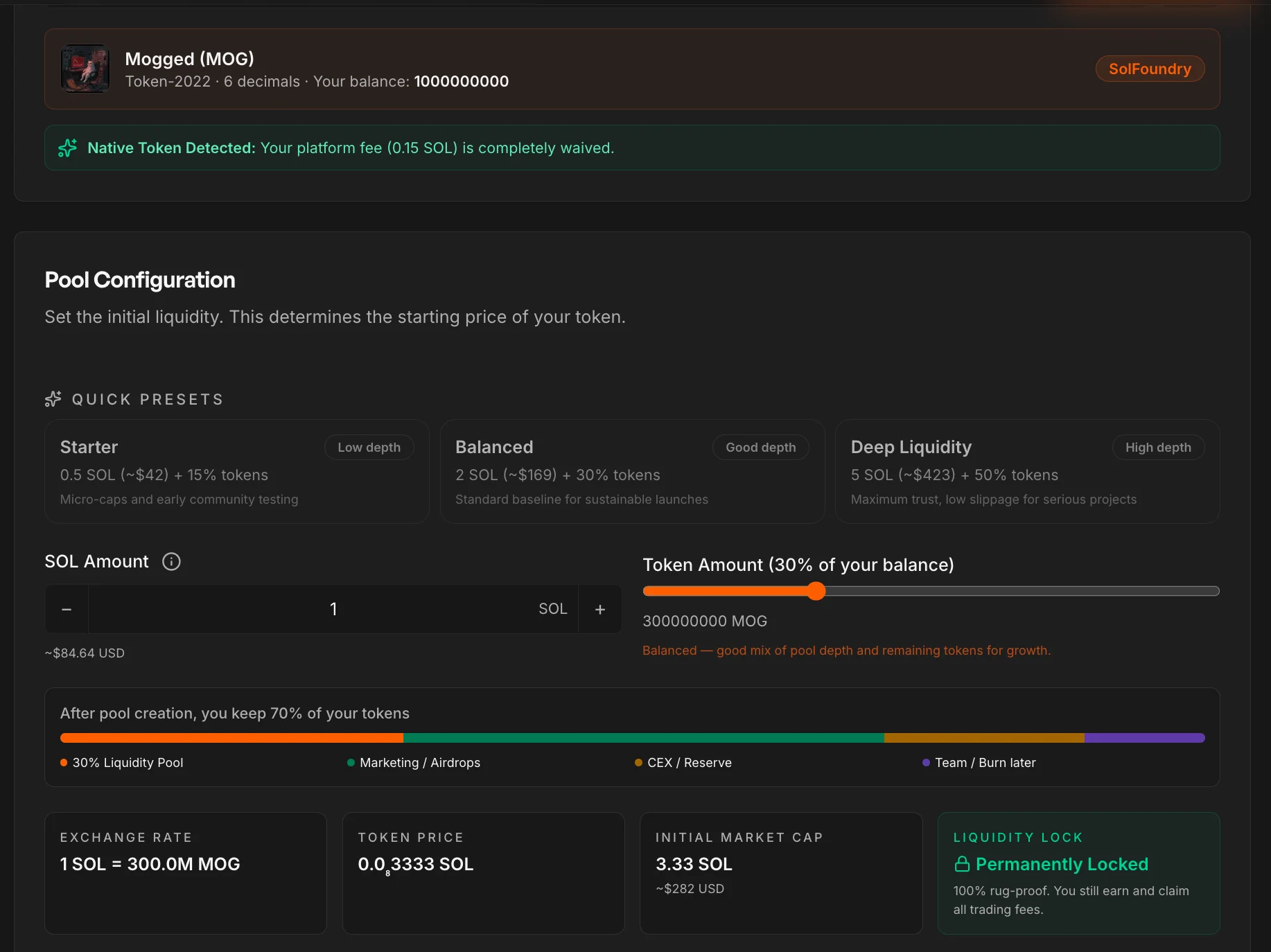
The pool is created and locked atomically, no separate transaction. LP fees stay claimable by the creator forever, even on the locked portion (Meteora's permanent lock keeps fee accrual live).
You still earn on locked liquidity. A permanent lock removes the rug vector but keeps fee accrual live — the creator claims trading fees on the locked pool forever. Trust signal and revenue, not a trade-off.
For the first 100 launches, the platform fee is zero. See the Early Supporter campaign.
What Doesn't Affect Your Liquidity Decision
A few things that founders agonize over but shouldn't drive the number:
Token decimals. Whether you use 6 or 9 decimals doesn't change how much SOL you need. The slippage math is in SOL terms, not token-unit terms.
Whether you're on a bonding curve vs. direct DEX pool. Bonding curves (like Pump.fun's) abstract liquidity, but the underlying math is the same, you just don't see it. Direct DEX pools are more honest about the trade-off.
Whether you're using anti-sniper protection. Protection changes the fee curve, not the liquidity depth. A 5 SOL pool with anti-sniper still has 5 SOL of slippage exposure to real buyers after the protection window closes.
FAQ
What's the absolute minimum I should put in? 1 SOL is the floor for any launch you want to be taken seriously. Below that, the chart looks like manipulation on every trade. Some founders launch with 0.3 SOL as a test; nobody buys those.
Is there a maximum I should worry about? For most launches, 100 SOL is the practical ceiling. Above that, you're locking real capital into a launch that may not work, with no recovery if it doesn't.
Can I add liquidity in a second wallet later? Yes, but holders see all wallet flows on-chain. Adding from a fresh wallet looks identical to founder accumulation. It doesn't trick anyone. If you want to add liquidity, do it from your launch wallet and lock it.
How does this compare to ETH or BNB launches? Different chains, different math. Ethereum launches typically need much higher liquidity ($50K+) because gas costs and slippage tolerance are different. Solana's lower fees mean smaller pools can still feel responsive.
What if my token has a non-1B supply? The same SOL ranges apply, but you should run the slippage math for your specific supply. A 10B supply token needs less SOL per dollar of market cap than a 100M supply token because the per-token price is smaller.
Should I match the pool to my expected market cap? Roughly. A common rule: initial liquidity should be ~10–25% of the market cap you're hoping to hit in week 1. Below 10%, the price is too easy to push up artificially. Above 25%, you're overcapitalizing for an unproven launch.
What if the launch fails? Locked liquidity is locked. If the pool dies and nobody trades, your SOL stays in the pool forever. This is the cost of trustlessness, you can't ask for a refund. Pick a number you're comfortable losing.
Can I lock the LP with an unlock timer instead of permanently? Technically yes; practically no. Any unlock timer is read by serious buyers as your exit window, not a "safety cushion." Permanent or nothing.
Ready to launch with the right liquidity for your community size, atomically locked? Head to SolFoundry's launch flow, the recommended range is calculated for your supply, the lock is permanent, and the LP fees stay yours forever.
Keep reading
What to Do After Launching a Solana Token: 5 Steps (2026)
Minted your Solana token, now what? 5 post-launch steps: seed real liquidity, put supply in the pool, lock the LP, run a rug check, survive hour one.
How to Burn Solana Tokens: Supply, LP & What It Does (2026)
Burn Solana tokens in one transaction, free. What burning actually does to supply and price, how LP burns differ from locks, and the mistakes that can't be undone.
Permanent Liquidity Lock vs Time Lock on Solana (2026)
Permanent vs time-locked liquidity on Solana: how each works, who uses them, and which one buyers actually trust. Honest 2026 comparison.