Solana Ticker Squatting: How Fake Tokens Clone Real Projects to Fool Buyers
A token scored 100/100 on our rug-check tool days before crashing 95%. Here's the blind spot we found, and the three checks we shipped to close it.
The token that scored 100/100
This week someone pasted a mint address into our rug-check tool and got back a 100, "Excellent," green across the board. Mint authority revoked. Freeze authority revoked. Metadata locked. Holders spread across enough wallets that concentration looked healthy.
By the time we actually looked at the token behind that score, it had already crashed 95% in under a day.
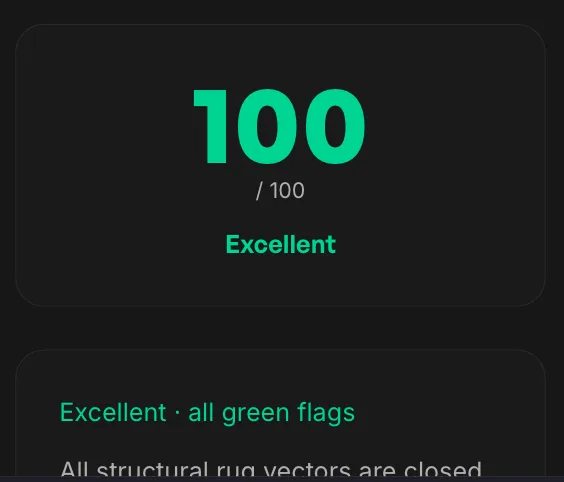
That's not a rounding error. That's the tool telling someone "this is safe" about a token mid-collapse. We went back through the checks we run and found the gap, then spent the rest of that day closing it. This is what we found and what we shipped.
What the old checks actually measured
The four flags we had, mint, freeze, metadata, and holder concentration, are all real signals. They answer one question: can the creator still hurt you structurally? Can they mint more supply, freeze your wallet, rename the token, or does one whale hold enough to tank the price on their own.
The token that scored 100 passed all four honestly. Mint and freeze really were revoked, that's standard for pump.fun launches. Metadata really was locked. And the top holders really were spread thin, because a violent pump-and-dump churns through hundreds of wallets in hours. High turnover looks like healthy distribution if you only check it once.
None of those four checks ask the question that actually mattered here: is this token being pumped and dumped right now? That's a different kind of risk than "can the dev rug me structurally," and we had zero coverage for it.
Fix 1: A trading-pattern check
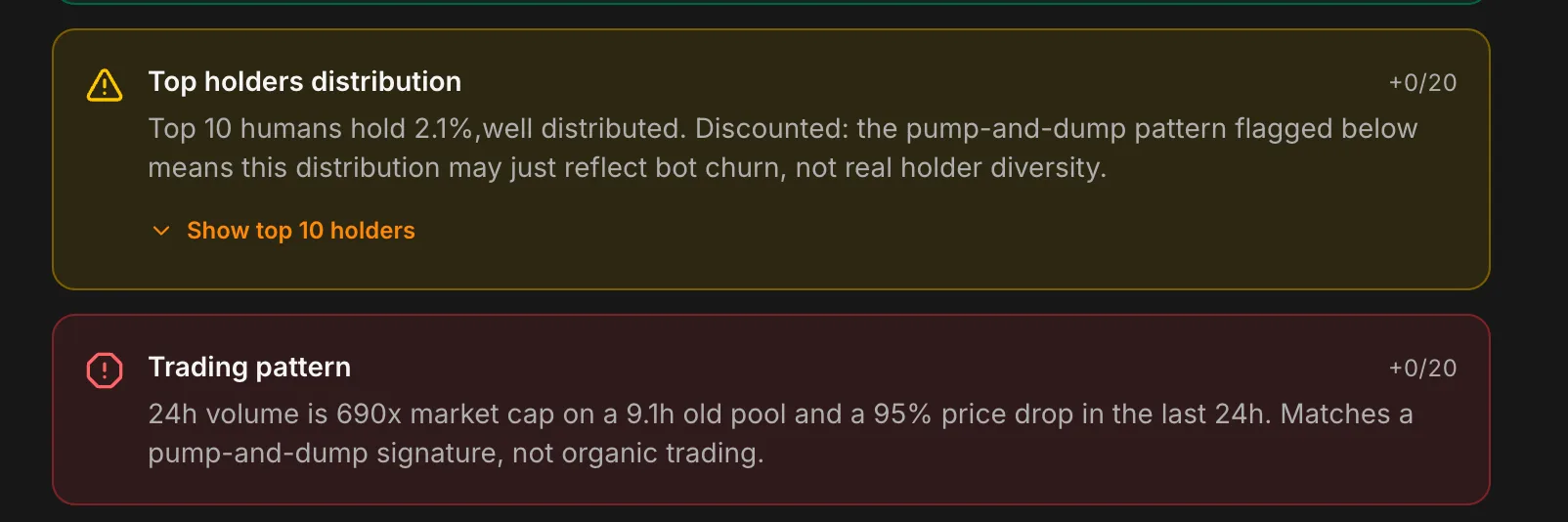
We added a fifth flag that looks at 24-hour trading volume against market cap, weighed against how old the liquidity pool is.
Why weigh it against pool age? A brand-new pool doing 5x its market cap in volume on day one is normal, that's price discovery while the market figures out where a token should trade. The same 5x ratio a week later, on a pool that should have settled, is a different story. Age is what turns a raw volume number into a signal.
We also check for a matching price crash in the same window. A token can spike in volume from legitimate hype without collapsing. It's the combination, extreme turnover plus a severe price drop, that flags. The token that started this whole investigation was sitting at roughly 690x its market cap in 24-hour volume when we checked it. That's not a token trading, that's a token being wrung out.
Fix 2: Ticker squatting
While we were rebuilding the scoring model, we found something else worth flagging: a token cloning another project's exact name and symbol.
The pattern is simple. Someone takes a ticker that already has recognition, an existing project's symbol, and launches a new token under the same name on a different mint address. Anyone searching by name or symbol instead of pasting the exact mint can land on the fake. We confirmed this isn't a hypothetical, we found a real case where a cloned ticker had accumulated over $50 million in liquidity on a completely different mint than the token it was copying.
That's not a small-time scam. That's enough liquidity to look completely legitimate to anyone who doesn't check the mint address character by character.
The mint address is the only thing that can't be faked. Name, symbol, and even the logo can all be cloned. Before you buy anything based on a ticker you recognize, paste the exact mint address you got from a trusted source, not a name you typed from memory, into the search.
Building a fair comparison
The hard part wasn't detecting a name match, DexScreener's search does that for free. The hard part was deciding when a match is worth warning about, without breaking the check for the real, original token.
Our first version tried to protect established tokens with a flat exemption: if a token was old enough or had enough liquidity, skip the collision check entirely. That fell apart immediately during testing. We ran a real, long-established token through it and found a second, unrelated token sharing its name with a genuinely huge liquidity pool of its own. Our flat exemption let both sides off the hook, including the exact kind of match we built the feature to catch.
The fix was to stop asking "is this token old enough to be safe" and start asking "how does this token compare to the other one sharing its name, right now." We pull every pool matching the token's symbol, sum liquidity per mint (a single project is often split across several pools, and we don't want fragmented liquidity to look weaker than it is), and compare relative age and relative size. A warning only fires when another token sharing the name is clearly more established, meaningfully older or meaningfully more liquid than the one you're actually checking. Check the original, and the comparison always favors it, so it stays clean.
Closing the loophole in the comparison itself
There was still a way to game this. Liquidity can be faked. Someone could wash-trade a clone into looking like it has real liquidity, enough to outrank the token you're actually checking, without any of it representing genuine buyer distribution.
So the comparison now also checks who holds the top candidate's supply. If the token that's "winning" the liquidity comparison also has extremely concentrated holders, most of the supply sitting in one or two wallets, we surface that alongside the warning instead of letting a fake liquidity number silently override the comparison.
Fix 3: One wallet vs. ten wallets
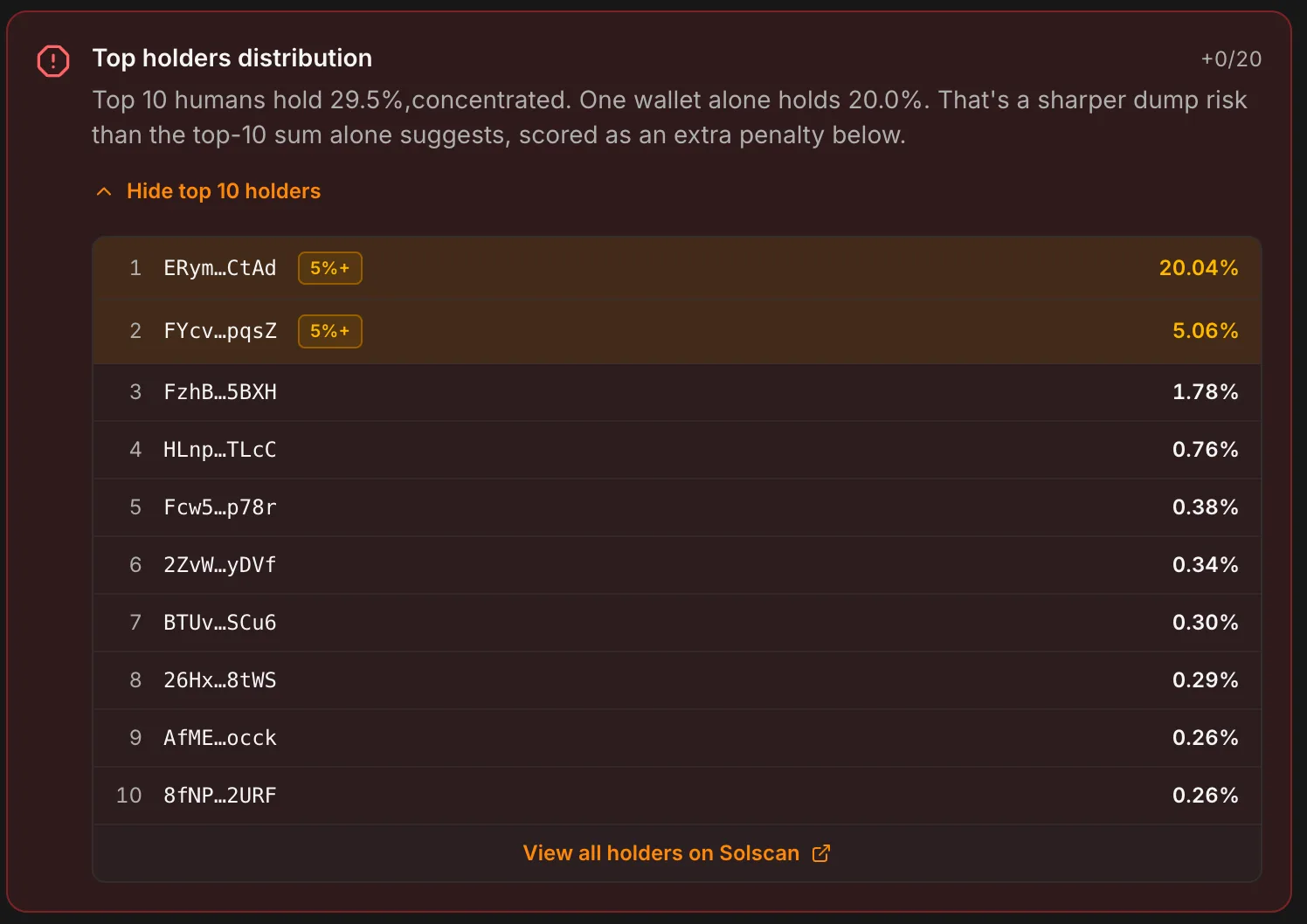
The third gap came from a token where the top-10 holder concentration read as a moderate 29%, our old bands treated that as "not great, not terrible." But one single wallet inside that top 10 held 20% on its own.
That's a materially different risk. Ten wallets splitting 29% roughly evenly means no single actor can move the market alone. One wallet holding 20% of that 29% means one person can crash the price whenever they decide to sell. The aggregate number was hiding the actual risk.
We now score the single largest non-LP holder separately, on top of the existing top-10 sum. A moderate aggregate with one dominant wallet inside it now scores meaningfully worse than the same aggregate spread evenly, and the score keeps getting worse the bigger that one wallet gets, it doesn't cap out early.
All three checks run automatically now.
Paste any Solana mint address and get trading-pattern, ticker-squatting, and single-holder risk checked alongside the original mint, freeze, and metadata flags. Takes a few seconds.
Run a Free Rug CheckWalking through a real example
Here's what all of this looks like together on an actual token we pulled up while testing the update, a clone using the name "Ansem." The real Ansem-linked token has been around for a while; this one was a same-day copy.
The score itself came in at 35/100, Danger.
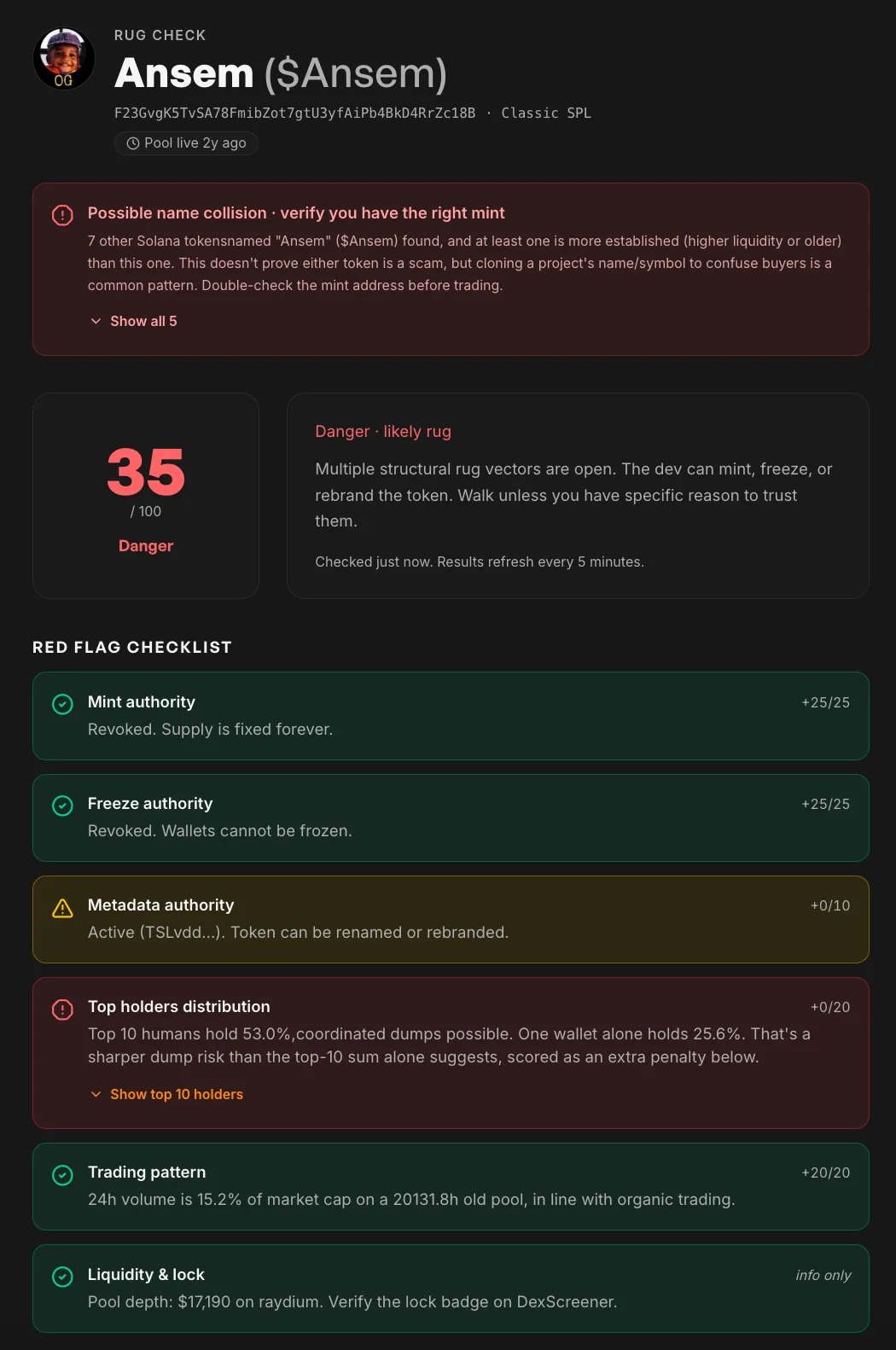
Three things were stacked on top of each other here. First, metadata authority was still active, the creator can still rename the token or swap its logo after you've bought in. Second, the name-collision check caught it immediately, seven other tokens on Solana share the exact same symbol, several older and more liquid than this one.
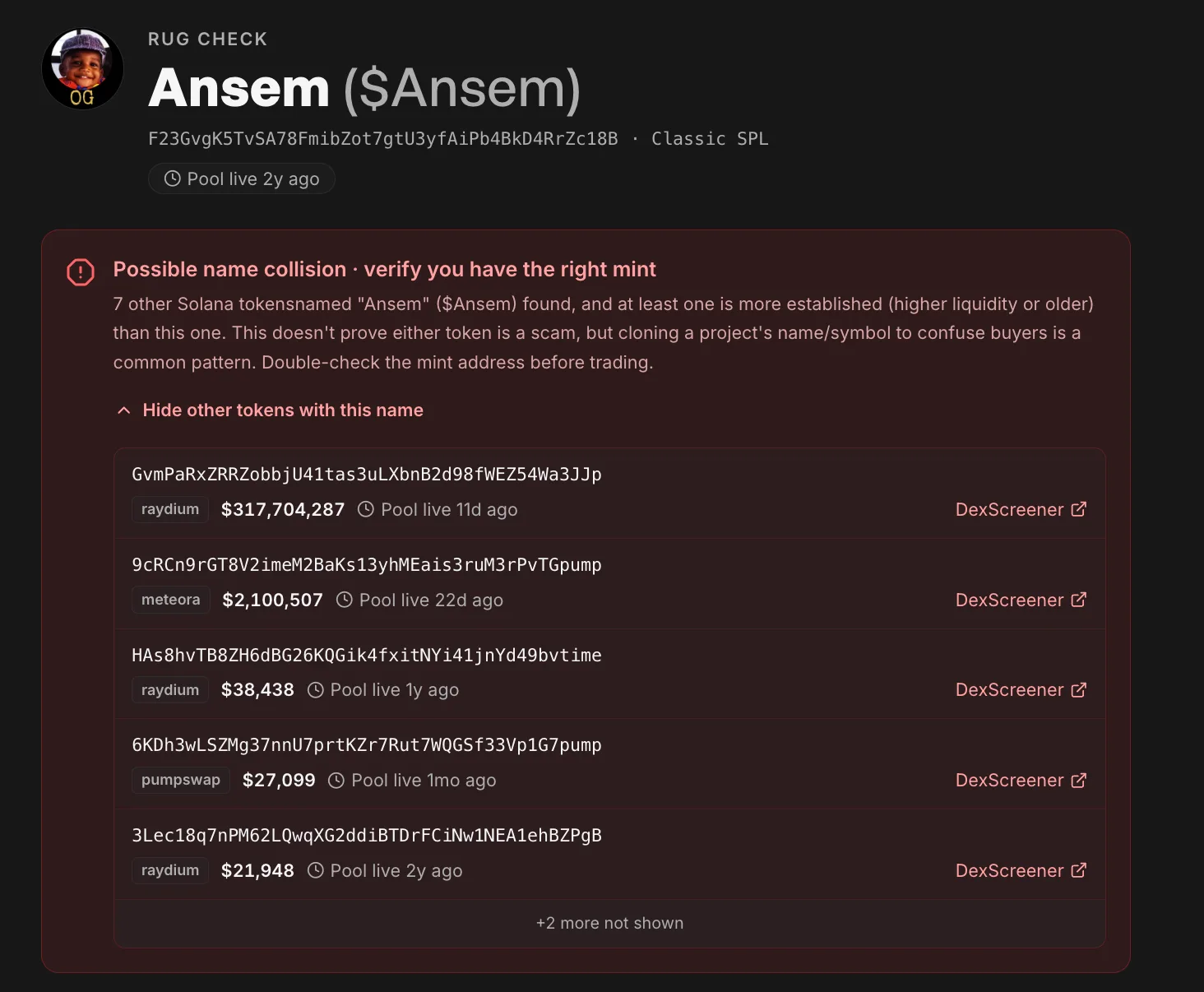
Third, top-10 holder concentration sat at 53%, already a red number on its own, but one wallet alone held 25.6% of total supply. That's the single-holder check doing exactly what it's meant to do: a 53% aggregate with one wallet at a quarter of the total supply is a very different risk than 53% spread across ten roughly-equal wallets.
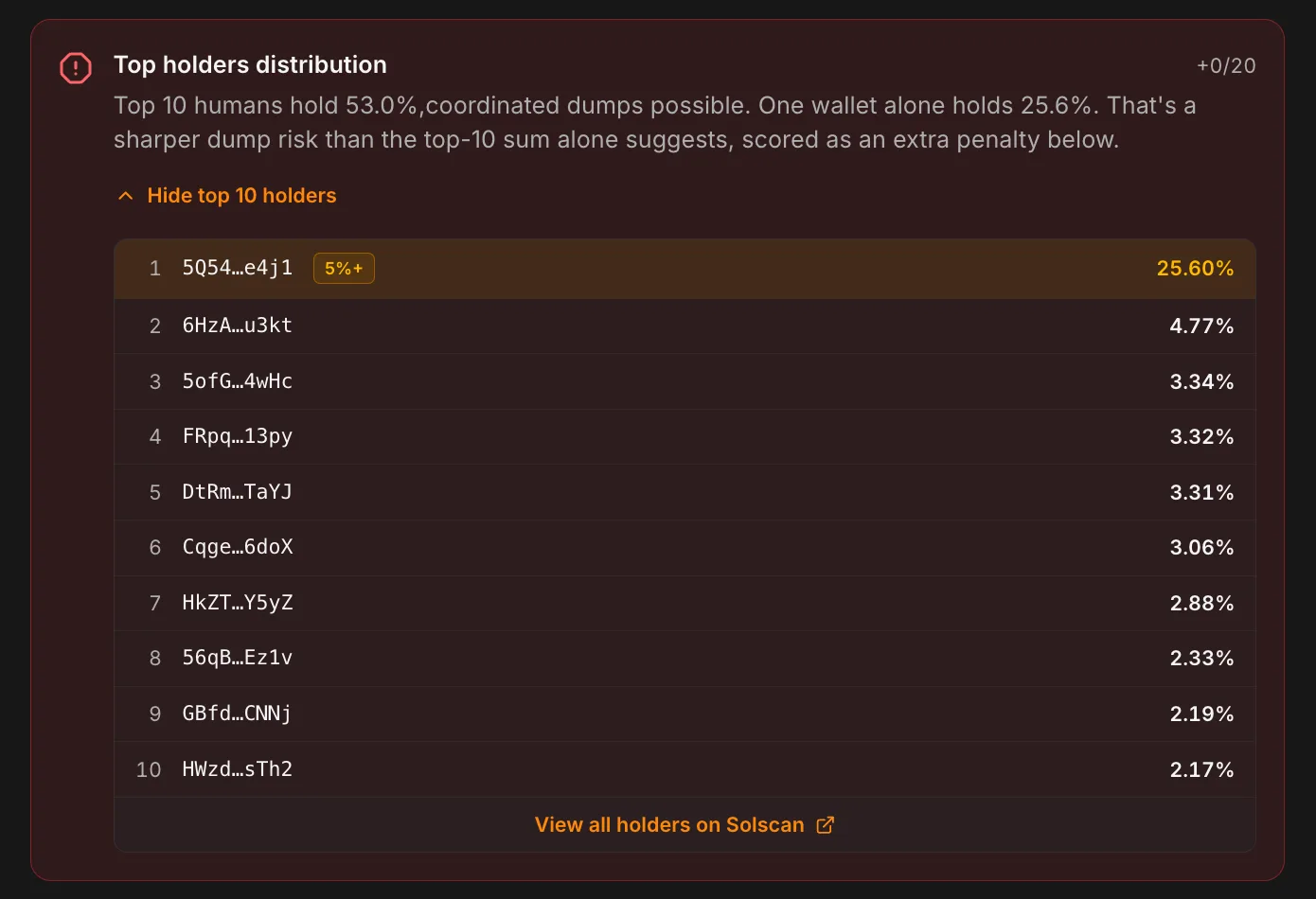
None of these three flags depend on the others to be useful. A token could fail just the trading-pattern check, or just the name-collision check, and still be worth walking away from. This one failed all three at once, which is exactly the kind of case the old four-flag version would have partially missed, the metadata flag alone wouldn't have been enough to push the verdict into Danger.
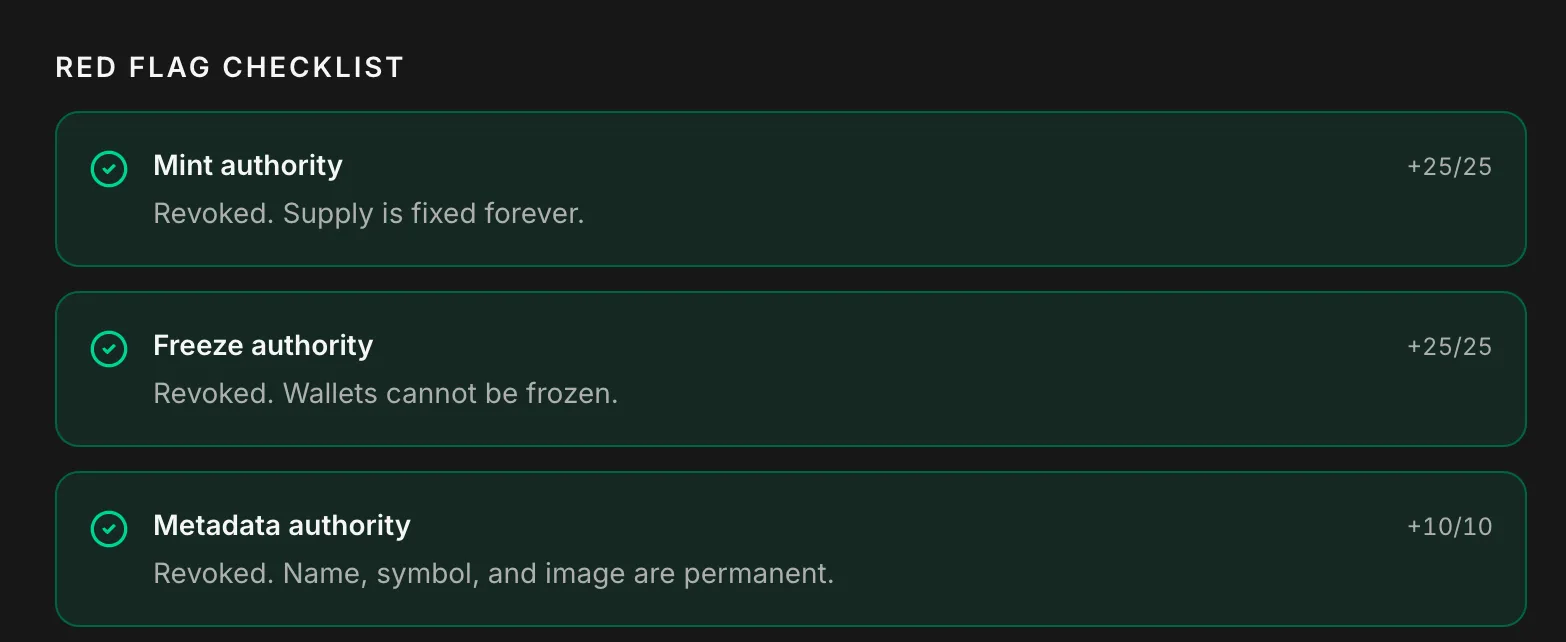
For contrast, here's a clean result, a token where the trading-pattern and holder-concentration checks both come back green, no red flags active.
What this doesn't catch
Worth being honest about the limits here, same as with our five-check rug-pull guide. These checks all read on-chain and market data. They don't read intent.
A token can pass every check we run today and still be a slow bleed, a project that quietly stops building and drifts to zero over months instead of hours. A coordinated Telegram dump can move fast enough that even a well-timed check misses the window. And any scoring model, ours included, is a snapshot. A token that's clean at the moment you check it can change an hour later.
Treat a good score as "no structural or behavioral red flags right now," not as a guarantee. It removes the obvious traps. It doesn't replace judgment about the team, the product, or why a token is getting attention in the first place.
FAQ
What is ticker squatting on Solana? Ticker squatting is when someone launches a new token using the exact name and symbol of an existing, often more established, project, on a completely different mint address. Buyers who search by name instead of verifying the mint can end up on the copy instead of the original.
How do I know which token is the real one? Compare liquidity and pool age. The original project's token is almost always older and more liquid than a same-name copy launched later. Our rug-check tool runs this comparison automatically and warns you when a more established token shares the name of the one you're checking. When in doubt, get the mint address directly from the project's official site or verified social account, never from a search result alone.
Can a token have healthy top-10 concentration but still be risky? Yes. A top-10 sum can look moderate while one single wallet inside that group holds a disproportionate share. That one wallet can move the market on its own regardless of how the other nine are split. That's why we score the single largest holder separately now, not just the aggregate.
Why did a pump-and-dump token pass the old checks? Because the old checks only measured structural rug vectors, whether the creator could still mint, freeze, or rebrand the token, plus overall holder spread. A token mid pump-and-dump often has none of those structural issues; the risk is in the trading pattern itself, extreme volume relative to market cap and a matching price crash, which the old checks never looked at.
Is this rug-check tool free? Yes. No wallet connection, no signup, no cost. Paste a mint address at solfoundry.io/rug-check and get a full report in seconds.
We shipped all three of these the same day we found the gap, they're live now on every rug-check report. If you've seen a rug pattern that you don't think a score like this would catch, we'd genuinely like to hear about it, the tool only gets better by running into the cases it misses.
Run a free rug check on any Solana token, or read the 5-check manual version if you'd rather verify it yourself.
Keep reading
Free Solana Rug Check: 0–100 Trust Score in 5 Seconds
Paste any Solana mint, get a 0–100 trust score in 5 seconds. Free, stateless, no signup. Built by SolFoundry on the same on-chain checks experts use.
How to Check if a Solana Token Is Safe (2026)
How to check if a Solana token is safe before you buy: the 5 on-chain flags that separate a real token from a rug, and the 10-second way to verify any mint.
How to Spot a Rug Pull on Solana in 2026 (5 Quick Checks)
Crypto holders lost $1.8B to rugs in 2025. Run these 5 on-chain checks on Solscan and DexScreener before buying any Solana token. Takes 30 seconds.