Token-2022 vs SPL on Solana: Which to Pick in 2026
Token-2022 unlocks transfer fees, embedded metadata, and extensions. Classic SPL stays simpler and universally supported. Side-by-side comparison for 2026.
The Short Answer
If you want built-in metadata, a protocol-level transfer fee, or any of the other token extensions, choose Token-2022. If you only need a simple meme coin and want maximum wallet/DEX compatibility with zero edge cases, classic SPL is still the safer default.
A common misconception in 2026: "I need Token-2022 for anti-sniper protection." Not true anymore. Anti-sniper protection on SolFoundry runs through Meteora's pool fee scheduler, it works on classic SPL and Token-2022 equally. More on that below.
This guide walks through both standards, the real trade-offs, and a decision flowchart at the end.
What Each Token Standard Actually Is
Solana has two production token programs:
Classic SPL Token (program ID Tokenkeg...), the original token standard. Simple mint, transfer, burn, freeze. Battle-tested since 2020. Every Solana wallet, DEX, and aggregator supports it.
Token-2022 (program ID TokenzQd..., also called "Token Extensions"), the newer program. Same core operations, plus a set of optional "extensions" that bolt extra behavior onto the mint or each token account. You opt into only the extensions you want; the rest cost nothing.
Both live on-chain at the same time. A token belongs to exactly one program, you choose at launch and can't migrate later.
The Features Token-2022 Adds
Token-2022's value is the extension list. The ones that actually matter for token launches in 2026:
Transfer Hook (powerful in theory, painful in practice)
A program that runs on every transfer, can read state, enforce rules, or block the transfer entirely. On paper this is the dream foundation for anti-sniper rules, allowlists, and on-chain royalties.
In practice in 2026: no major liquidity venue routes transfer-hook tokens reliably. Meteora supports them with per-token approval, but aggregators and other AMMs frequently skip hook tokens or fail mid-route. A token that can't be aggregated is effectively untradeable. This is why SolFoundry doesn't ship transfer hooks for tradeable launches, the hook executes, but the token never gets to a market that respects it.
If you're building a closed system (gated allowlist, internal credentials), transfer hooks are still the right tool. For public token launches that need DEX liquidity, skip them.
Metadata Pointer + Metadata Extension
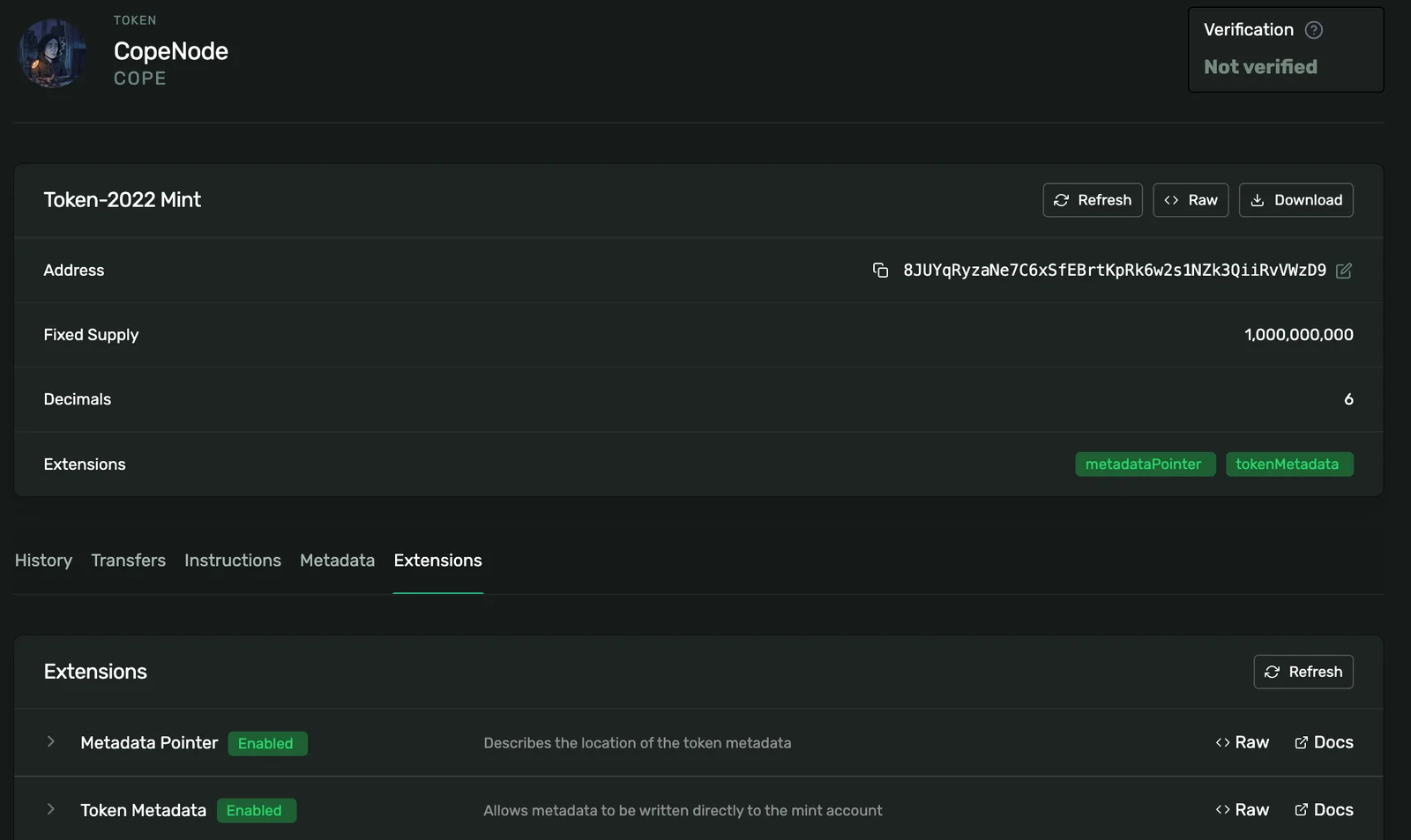
Classic SPL stores metadata in a separate Metaplex account that has to be created, signed, and revoked. Token-2022 lets the mint itself carry metadata directly. Cheaper, fewer moving parts, harder to mess up the authority revocation.
Transfer Fee
A configurable fee on every transfer, paid in the token itself. Can fund a treasury, burn supply, or reward holders. Different from a transfer hook because it's enforced by the program itself, no custom code needed.
Interest-Bearing Tokens
The token's displayed balance grows over time at a configurable rate. The underlying supply doesn't actually change, wallets show the rebased value. Niche, but useful for staking-like UX.
Confidential Transfers
Hides transfer amounts using zero-knowledge proofs. Live on mainnet but rarely used for retail tokens, most users want public on-chain history.
Permanent Delegate
A wallet that can transfer or burn from any account, no signature needed. Useful for compliance/recovery flows. Avoid for retail tokens, buyers will (correctly) treat it as a backdoor.
Non-Transferable
Soulbound tokens. They can be minted but never transferred. Good for credentials and badges, irrelevant for tradeable launches.
Where Classic SPL Still Wins
Classic SPL has one durable advantage: everything supports it, everywhere, with no asterisks.
Specifically:
- Older bots and tools, pre-2024 trading bots and indexers may silently skip Token-2022 mints. If your launch leans on bot liquidity, this matters.
- Some niche DEXes, most have updated, but not all. If you're targeting a specific long-tail venue, verify first.
- Hardware wallet edge cases, most Ledger and Trezor flows handle Token-2022, but unusual extension combinations can confuse signing UIs. Plain SPL never does.
- Mental model simplicity, no extensions to audit, no transfer hooks to verify. Buyers understand exactly what the token does.
If your token is a pure meme coin with no on-chain rules and you don't need anti-sniper protection, classic SPL ships in fewer trust signals to explain.
Wallet & DEX Support in 2026
For tokens without transfer hooks (the practical case for tradeable launches), Token-2022 has near-parity with classic SPL:
| Surface | Classic SPL | Token-2022 (no hook) | Token-2022 (with hook) |
|---|---|---|---|
| Phantom | Full | Full | Displays, but transfer UX warns |
| Solflare | Full | Full | Same |
| Backpack | Full | Full | Same |
| Ledger | Full | Full | Mixed |
| Jupiter | Full | Full | Often skipped by aggregator |
| Meteora DAMM v2 | Full | Full | Approved-token gate |
| Raydium AMM | Full | Full | Not supported |
| DexScreener | Full | Full | Indexed, trades may fail |
| Birdeye | Full | Full | Same |
Bottom line: Token-2022 with a metadata extension or a transfer fee is fully tradeable everywhere. Token-2022 with a transfer hook is a research/closed-system tool, not a public launch tool, that's why anti-sniper protection moved to the pool layer instead.
Use Cases, When to Choose Each
Choose Token-2022 if you want:
- Built-in metadata without a separate Metaplex account
- A protocol-level transfer fee (treasury, burn, rewards)
- Any future extension you might toggle on later (interest, confidential, etc.)
Choose classic SPL if:
- You're launching a simple meme coin with no on-chain rules
- Your audience uses older tools that haven't updated
- You want zero compatibility surface area to debug
- You're publishing as part of a multi-chain bridge that's SPL-only
In practice for Solana-native launches in 2026: start with Token-2022 unless you have a specific reason not to. The metadata extension alone makes it slightly cheaper and cleaner.
The Anti-Sniper Angle (Why It's Independent of Token Standard)
The most popular myth: "I need Token-2022 to stop snipers." Outdated.
Sniper bots win because the first second of a launch is unregulated, bots accumulate 10-30% of supply at the listing price, then dump on real buyers minutes later. The defense doesn't have to live inside the token program; it can live inside the liquidity pool.
SolFoundry's anti-sniper protection runs through Meteora DAMM v2's fee scheduler. At pool creation, the trading fee starts extreme (e.g. 90%) and decays to a normal level (e.g. 1%) over a configurable window. Snipers buying in the first seconds pay punishing fees that flow into the locked LP, fees that you, the creator, claim later.
Why this is structurally better than the transfer-hook approach:
- Works on classic SPL and Token-2022 equally, no token-program dependency
- Aggregator-safe, Jupiter, Birdeye, etc. route through Meteora normally
- No per-token approval gate, every Meteora pool ships with the same plumbing
- Sniper money becomes your money, high early fees go to LP, which is locked → claimable by you
- No custom on-chain program in the transfer path, fewer audit surfaces, lower risk
The earlier industry consensus that "anti-sniper requires Token-2022 transfer hooks" assumed liquidity venues would route hook tokens. They don't, in practice. Pool-layer protection is the working answer.
Deep-dive on how the fee scheduler defeats snipers.
Costs Compared
For a standard launch on SolFoundry:
| Item | Classic SPL | Token-2022 |
|---|---|---|
| Mint creation | ~0.002 SOL | ~0.003 SOL |
| Metadata account | ~0.012 SOL (separate Metaplex) | ~0.005 SOL (built-in extension) |
| Total on-chain rent | ~0.014 SOL | ~0.008 SOL |
| Platform fee | Same | Same |
| Anti-sniper protection | Free (Meteora pool) | Free (Meteora pool) |
Token-2022 is slightly cheaper for a standard launch because the metadata extension replaces the separate Metaplex account. Anti-sniper protection costs the same on both, it's a pool-config decision, not a token-config decision.
How to Choose: Decision Flowchart
Walk through these in order:
- Do you want a transfer fee, interest, or any other extension? → Token-2022
- Is your audience using pre-2024 tools you can't update? → Classic SPL
- Do you need to bridge to a chain that only supports SPL? → Classic SPL
- None of the above? → Token-2022 by default, slightly cheaper, keeps optionality, no real downside
Note that anti-sniper protection isn't on this list. It's a pool-level decision and works the same on both standards.
What SolFoundry Defaults To
SolFoundry lets you pick either standard at launch. Defaults:
- Quick Launch, Token-2022 with metadata extension, no transfer hook
- Advanced Launch, your call on every parameter, including standard
Anti-sniper protection is configured at the pool step, not the token step. You can combine SPL + anti-sniper or Token-2022 + anti-sniper interchangeably.
FAQ
Can I migrate a classic SPL token to Token-2022 later? No. The token's program is fixed at mint creation. You'd have to launch a new token and run a swap/airdrop, which is messy and resets your trading history.
Will classic SPL be deprecated? Not on any announced timeline. Both programs are core Solana infrastructure and will keep running. Token-2022 is the recommended default for new launches, not a replacement.
Does Token-2022 break Phantom or Solflare? No. Both support Token-2022 fully, including the extensions UI. The "Token-2022 doesn't work in wallets" story is from 2023 and outdated.
Does my Token-2022 token need approval to trade on Meteora? Only if it has a transfer hook, and SolFoundry doesn't ship transfer hooks for tradeable launches. Plain Token-2022 (metadata or transfer fee only) trades like any other token, no approval gate.
So how does SolFoundry stop snipers if the transfer hook isn't being used? Through Meteora DAMM v2's pool fee scheduler, fees start very high and decay over time. Snipers in the first seconds pay punishing fees that flow into your locked LP. It works on both SPL and Token-2022, with no custom on-chain program in the transfer path.
Can I add extensions after launch? Most extensions are mint-creation-only. A few (like the metadata content itself) can be updated if the authority isn't revoked. Plan your extensions before you launch.
Are transfer hooks a security risk? Only if the hook program is malicious. A well-audited hook is no riskier than any other on-chain program. The bigger practical risk is that hook tokens often can't be routed by aggregators, which makes them untradeable, regardless of whether the hook itself is safe.
Does Token-2022 cost more in network fees per transfer? Slightly, a few thousand extra compute units per transfer for the extensions to run. In practice, fractions of a cent. Not a real factor.
Ready to launch? On SolFoundry, picking Token-2022 takes one click, and anti-sniper protection is configured at the pool step, free, on either standard. Start your launch at solfoundry.io.
Keep reading
Best Solana Launchpad 2026: 7 Platforms Ranked by Use Case
The best Solana launchpad in 2026 depends on your launch. Honest rankings for speed, sniper protection, creator fees, and trust — Pump.fun, LetsBonk, Heaven, Bags.fm, PinkSale, and SolFoundry.
Solana Token Launch Cost 2026: DIY vs Pump.fun vs SolFoundry
Real cost to launch an SPL token on Solana in 2026. Side-by-side prices for DIY, Pump.fun, Moonshot, and SolFoundry. The hidden fees most launchpads hide.
What to Do After Launching a Solana Token: 5 Steps (2026)
Minted your Solana token, now what? 5 post-launch steps: seed real liquidity, put supply in the pool, lock the LP, run a rug check, survive hour one.