Cheapest Way to Launch a Token on Solana (2026)
The cheapest way to launch a token on Solana in 2026 — DIY vs Pump.fun vs SolFoundry. Real numbers, the fee that compounds against you, and where cheap gets expensive.
The Short Answer
The absolute cheapest way to launch a token on Solana is the DIY route via the CLI, at roughly 0.03 SOL in on-chain rent and network fees. The cheapest way that still gives you a tradeable token with locked liquidity and anti-sniper protection is a flat-fee launchpad at around 0.20 SOL.
But "cheapest" is the wrong question if you stop at the headline number. The fee you pay at launch is almost always rounding error next to two costs that don't show up on the pricing page: the percentage fee that compounds on every trade, and the supply snipers extract in the first block. This guide ranks every option by what it actually costs you, not what it advertises.
The Three Costs That Actually Matter
Before comparing prices, separate the launch into the costs that decide your real bill:
- Launch fee: what you pay once to create the token. Usually the smallest number.
- Ongoing trade fee: a percentage some platforms take on every buy and sell, forever.
- Sniper extraction: supply bots capture at t=0 and dump into your first buyers.
A platform can be "free" on cost 1 and the most expensive option on the planet on costs 2 and 3. That's the trap.
Cheapest to Most Expensive, Ranked
| Method | Launch fee | Ongoing fee | Anti-sniper | Real cost |
|---|---|---|---|---|
| DIY via CLI | ~0.03 SOL | none | not available | cheap fee, 3-8 hrs of your time, no protection |
| Pump.fun | 0 SOL | 1% every trade forever | none | "free" until volume, then the costliest |
| SolFoundry | 0.20 SOL | none | free | flat, predictable, protected |
| PinkSale & multi-chain pads | 0.5-2 SOL | + % of raise | paid add-on | expensive base + extras |
| Hire a developer | $500-5,000 | none | manual | overkill, plus authority risk |
1. DIY via the Solana CLI: cheapest fee, highest effort
If you're comfortable on the command line, you can mint an SPL token, attach Metaplex metadata, and pay nothing but rent:
| Item | Cost |
|---|---|
| SPL token + mint rent | ~0.004 SOL |
| Metaplex metadata rent | ~0.012 SOL |
| Metadata hosting (Arweave) | ~0.01 SOL |
| Network fees | ~0.001 SOL |
| Total | ~0.03 SOL |
What you don't get: a liquidity pool, a locked LP, anti-sniper protection, authority revocation, or a page buyers can view. You build and verify all of it by hand, and a single misconfigured authority is a rug vector you created by accident. Realistically 3-8 hours for a first-timer.
It's the cheapest line item and the most expensive use of your time.
2. Pump.fun: free to start, the fee that compounds
Pump.fun costs nothing upfront. Your token launches on a bonding curve and trades instantly. The catch is the 1% fee on every trade, in perpetuity:
| Trading volume | Pump.fun fee (1%) |
|---|---|
| $100K | ~$1,000 |
| $500K | ~$5,000 |
| $1M | ~$10,000 |
There's also no anti-sniper mechanism, and the bonding-curve format actively rewards the first wallet in, which buys lowest and dumps into your community. So you pay nothing at launch, then potentially thousands in trade fees and lose a chunk of supply to bots. "Free" is only true if your token never does volume.
3. SolFoundry: flat fee, no percentage, protection included
SolFoundry charges a transparent flat fee and takes zero percentage of trades:
| Item | Cost |
|---|---|
| Quick Launch | 0.20 SOL |
| Advanced Launch | 0.30 SOL |
| AI concept + artwork | 0.10 SOL (optional) |
| Anti-sniper fee scheduler | Free |
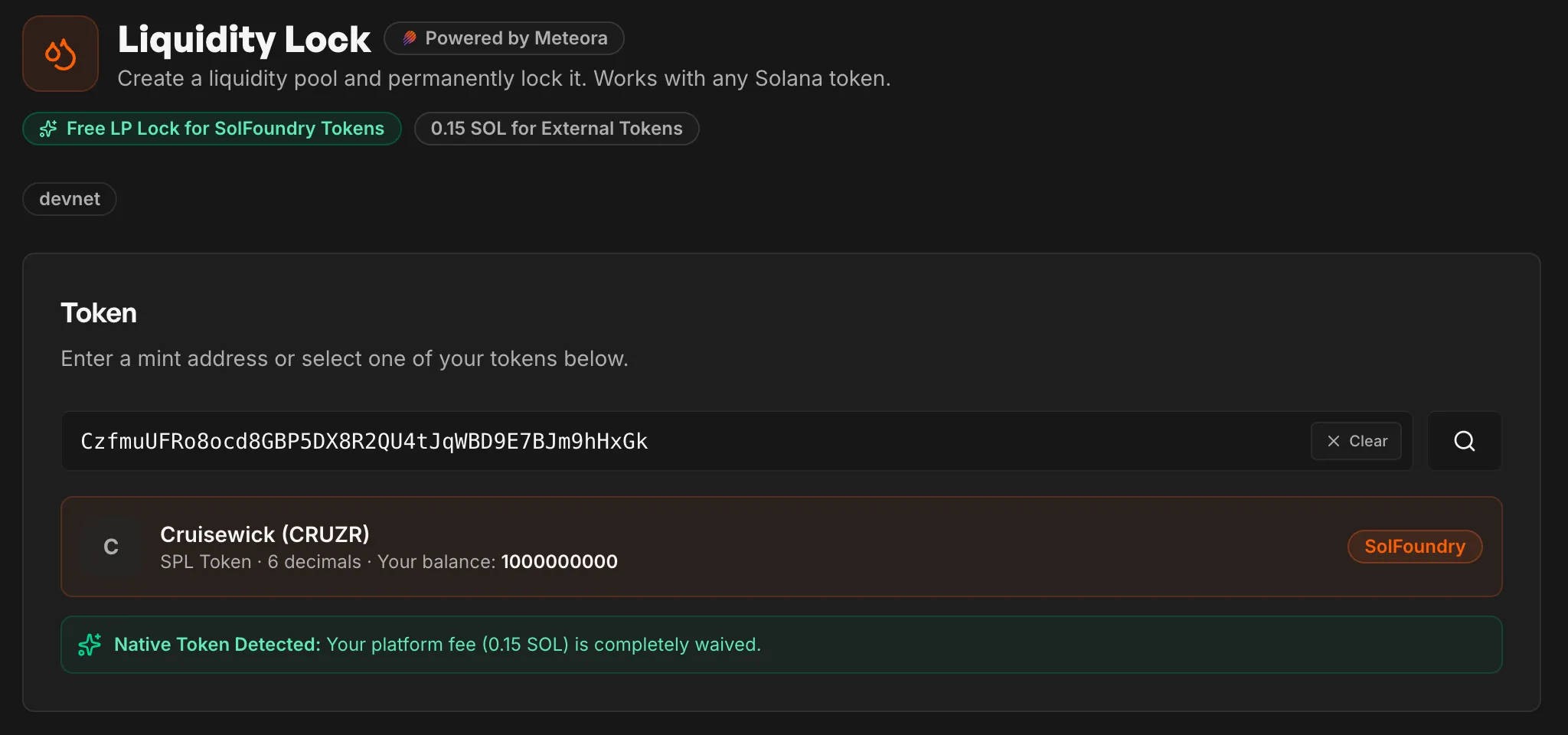
| Permanent LP lock (native tokens) | Free |
| Network fees | ~0.01 SOL |
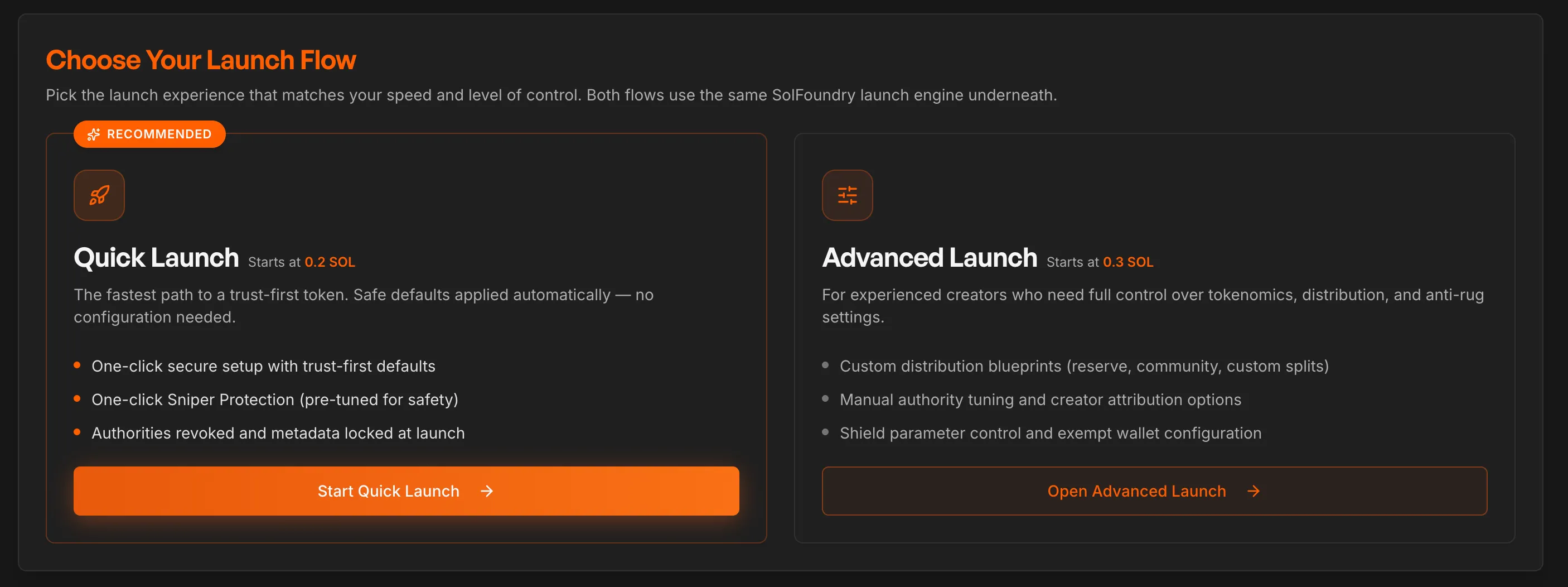
At roughly $150/SOL, that's about $30 once, and it stays flat regardless of whether your token does $10K or $10M in volume. Liquidity locking and the anti-sniper fee decay come included rather than as paid add-ons, and the high early fees snipers pay flow back into your locked LP instead of to the platform. Full breakdown in our Solana token launch cost guide.

Notice what dominates the total: the platform fee is 0.00, and almost all of the 1.06 SOL is the liquidity you keep in your own locked pool. The fee to launch is rounding error; the liquidity is the number that matters.
4. PinkSale and multi-chain launchpads: built for funded teams
Established multi-chain pads charge 0.5-2 SOL base, then stack anti-bot, lock, and KYC/audit fees on top, often plus a percentage of funds raised. Powerful for a funded team running a presale; overkill and overpriced for an individual creator or a meme launch.
5. Hiring a developer: most expensive, with a hidden risk
A freelance Solana dev runs $500-5,000. Beyond cost, the real danger is a "developer" who launches your token and quietly keeps mint or freeze authority. Always verify every authority was revoked before the final payment.
Where "Cheap" Quietly Gets Expensive
A $50K-volume launch in the first 90 seconds, on a platform with no anti-sniper, reliably loses 10-25% of supply to block-0 bots. At 20% extraction, that's $10,000 removed from your community in under two minutes, to save a launch fee of a few dollars. The math isn't close. This is why we treat anti-sniper protection as part of the cost of launching, not an extra. See how to protect your token from snipers.
The other quiet cost is the unlocked LP. Without a visible lock badge on DexScreener, organic buyers assume rug risk and skip your token, so you pay in lost demand instead of in SOL. What liquidity locking is and why it matters.
So What's Actually Cheapest?
- You're a developer testing throwaway ideas? DIY CLI at ~0.03 SOL is unbeatable on fee. You accept no protection and your own time as the cost.
- You're spinning up disposable memes by the dozen? Pump.fun's zero upfront is rational, as long as none of them do real volume.
- You're launching one token you want holders for? A flat-fee launchpad at ~0.20 SOL with locked LP and anti-sniper included is the cheapest real cost, because it removes the two fees that compound against you.
The cheapest launch fee and the cheapest launch are rarely the same thing.
Frequently Asked Questions
What is the absolute minimum to launch a token on Solana?
About 0.03 SOL for on-chain rent and network fees if you do everything yourself via the CLI. But you still need liquidity (1+ SOL) for the token to be tradeable, so the realistic floor to launch and trade is higher.
Is Pump.fun really free?
There's no upfront fee, but Pump.fun takes 1% of every trade forever. A token doing $1M in volume pays roughly $10,000. A flat 0.20 SOL fee (~$30) is cheaper the moment your token does any meaningful volume.
Do I have to pay extra for anti-sniper protection?
On most platforms, yes, typically 0.2-0.5 SOL. On SolFoundry it's included free via the Meteora fee scheduler, and the fees snipers pay flow into your locked liquidity.
How much liquidity do I need on top of the launch fee?
At least 0.5-1 SOL to test, 2-5 SOL for a real launch. Below 0.5 SOL means brutal slippage and zero credibility, no matter how cheap the launch fee was.
Is the cheapest option ever the right one?
For throwaway tests, yes. For a token you want a community around, the cheapest fee (Pump.fun's zero, or DIY's 0.03 SOL) usually carries the highest real cost through trade fees, lost supply, or your own hours.
Ready to Launch?
If you want the cheapest real cost (a flat fee, no percentage on trades, with locked LP and anti-sniper protection included), that's what we built. Start at solfoundry.io/liquidity-lock.
Sources
Keep reading
Free Solana Token Launch 2026: What's Actually Free
Free Solana token launch in 2026: platform fee 0, network ~0.02 SOL, no trade-fee tax. Honest math vs Pump.fun's 'free'. First 100 launches included.
Best Solana Launchpad 2026: 7 Platforms Ranked by Use Case
The best Solana launchpad in 2026 depends on your launch. Honest rankings for speed, sniper protection, creator fees, and trust — Pump.fun, LetsBonk, Heaven, Bags.fm, PinkSale, and SolFoundry.
How to Launch a Coin Like Pump.fun (But With Locked LP)
Want to launch a coin like Pump.fun but without the sniper problem? Here's the Pump.fun model explained, where it costs you, and how to get the speed with locked liquidity.